
To choose a reliable IPTV provider, check its content authorization, confirm that it carries the channels you need, and evaluate playback on your own devices before committing. Clear subscription terms, useful customer support, and straightforward cancellation matter as much as picture quality.
A large channel count or a low price cannot tell you whether a service will suit your household. Focus on what you can verify: the package you are buying, how it performs during your usual viewing hours, and what happens when something goes wrong.
What should you check before comparing IPTV providers?
Start with your viewing needs. A provider is only useful if it delivers the programs you want on the devices you use, within your budget and location.
Write down:
- Your essential channels, sports competitions, and language preferences.
- Whether you mainly watch live TV, movies, or on-demand series.
- The devices you plan to use.
- How many people need to watch different programs simultaneously.
- Whether subtitles, accessibility features, recording, or catch-up TV are essential.
- Your maximum total monthly cost.
Separate essential features from optional extras. This makes it easier to reject an unsuitable package, even when its advertised catalog looks impressive.
How can you assess whether an IPTV provider is legitimate?
Look for an identifiable business and credible evidence that it is authorized to distribute the content it sells. Internet delivery alone does not establish whether a service has permission to offer particular channels or programs. Unauthorized streaming involves providing or accessing content without the copyright owner’s permission.
Check the company’s business details, terms of service, and explanation of where its service is available. Where possible, confirm an authorized distribution relationship through the broadcaster or content owner.
Treat a provider’s own statement that it is “fully licensed” as a claim to investigate. A professional website, a working stream, or a successful payment does not independently verify distribution rights.
An unusually cheap package promising virtually every premium channel deserves closer scrutiny. Price alone does not prove wrongdoing, but unanswered questions about content authorization are a reason to choose another service.
How do you verify the channels and features you actually need?
Check the exact subscription package and your location. General advertising may describe features that are available only in certain plans, on selected channels, or through additional purchases.
Ask for a current channel lineup and search for your essential channels by name. For sports, check the specific competition and coverage you want rather than relying on a broad “sports included” label.
Clarify these distinctions:
| Advertised feature | What you should confirm |
|---|---|
| Large channel catalog | Your essential channels are included in the selected package |
| HD or 4K viewing | Which programs support that quality on your device |
| Catch-up TV | Which channels support replay and how long programs remain available |
| Recording | Storage limits, retention periods, and playback restrictions |
| On-demand library | Whether the titles, audio languages, and subtitles you need are available |
| Multiple devices | How many can play different streams at the same time |
An electronic program guide, or EPG, is the schedule displayed inside the service. Check whether its listings match the channels and your local time. A guide that is difficult to navigate can make an otherwise suitable package frustrating to use.
How should you test streaming reliability?
Evaluate the service under the conditions in which you will normally watch it. A brief demonstration on someone else’s device provides little evidence about performance in your home.
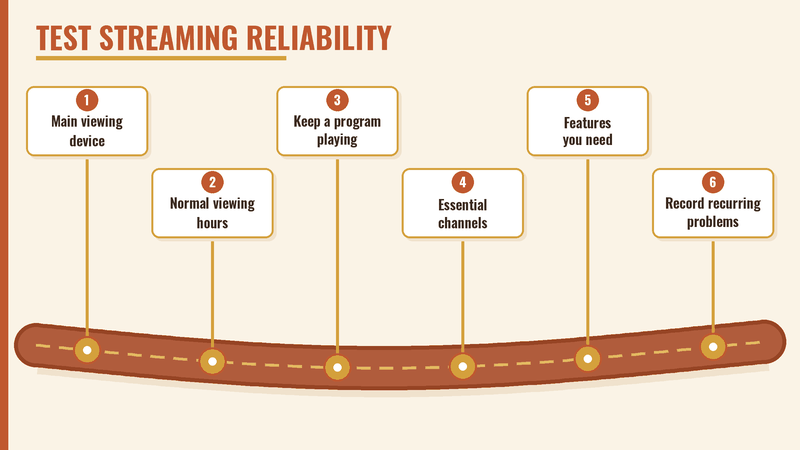
When a trial or short subscription is available, use this process:
- Use your main viewing device. Test the television, streaming box, or other device you expect to use regularly.
- Watch during your normal viewing hours. Include an evening session or a relevant live event when possible.
- Keep a program playing. Watch long enough to notice recurring pauses, picture changes, audio problems, or disconnections.
- Switch between essential channels. Check whether they load consistently and display the correct program.
- Try the features you need. Test subtitles, replay, recording, and additional streams where included.
- Record recurring problems. Note the channel, time, device, and symptoms so support can investigate.
A successful trial is useful evidence, but it cannot guarantee future performance.
How can you distinguish service problems from connection problems?
Check your home connection before deciding that every interruption is the provider’s fault. Other devices using the network can contribute to buffering, and playback requirements depend on the service and picture quality.
As a practical comparison, try another supported device or an Ethernet connection where available. Compare the affected channel with other channels and another legitimate streaming service.
These checks can help narrow the problem. They do not conclusively identify the cause, since different services can behave differently on the same connection.
Will the service work properly on your devices?
Confirm support for your exact device model and operating system before paying. “Works on smart TVs” is too vague to establish compatibility with your television.
Ask whether you need the provider’s own app, a browser, a supported set-top box, or a separate IPTV player. Check whether any player requires an additional purchase.
An IPTV player and an IPTV subscription serve different purposes. Buying a player does not automatically include television channels or authorize access to a provider’s content.
Also clarify the difference between installation and simultaneous viewing. Permission to install an app on several devices does not necessarily mean that everyone can watch at once. Check household and location restrictions as well. Streaming allowances can depend on whether devices are connected to the designated home network.
How can you judge customer support before subscribing?
Contact support with a specific question that matters to your setup. The usefulness of the answer gives you more information than a general promise of round-the-clock assistance.
Ask about your device, an essential channel, the connection allowance, or a cancellation condition. Look for an answer that addresses the question directly and agrees with the written subscription terms.
Check:
- Available contact methods and support hours.
- Whether technical help continues after payment.
- How service interruptions are communicated.
- Whether there is a clear route for unresolved billing or account problems.
A fast sales reply is encouraging, but it does not establish how well the company handles technical problems. Use any trial-related issue as an opportunity to assess that response.
What subscription and payment terms should you read?
Understand the full price, renewal arrangement, and cancellation process before entering payment details. A free trial may convert into a paid subscription automatically, so check its deadline and the steps required to cancel.
Confirm whether the quoted price includes taxes, activation, required software, and additional connections. Check whether a promotional price changes at renewal.
Read refund terms separately from cancellation terms. Stopping a future renewal and receiving money back for an existing payment are different outcomes.
Keep a copy of the offer, receipt, and relevant support messages. When you are still evaluating a provider, consider a shorter commitment if the available terms and price make sense.
How much should you trust IPTV reviews?
Use reviews to identify patterns worth investigating. Avoid treating a star rating or a single enthusiastic recommendation as proof of reliability.
Read recent feedback from several places and look for specific descriptions of playback, billing, support, and cancellation. Reviews can be fake, misleading, or influenced by incentives, and appearance alone cannot reliably establish authenticity.
Give more attention to comments that explain the customer’s device, location, subscription period, and problem. Those details help you judge whether the experience is relevant to your situation.
Repeated complaints deserve follow-up questions. They still need context, particularly when they concern an older version of the service or a different package.
Which warning signs should make you reconsider?
Pause when a provider leaves important questions unanswered or pressures you to pay before you can inspect the offer.
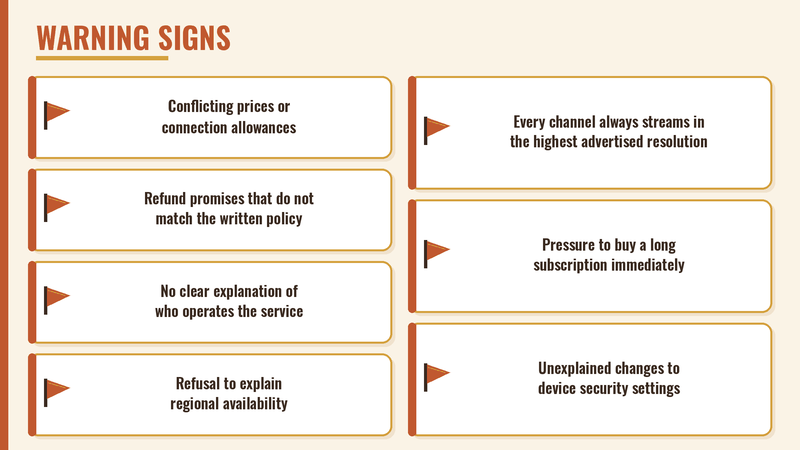
Warning signs include:
- Conflicting prices or connection allowances.
- Refund promises that do not match the written policy.
- No clear explanation of who operates the service.
- Refusal to explain regional availability or content authorization.
- Claims that every channel always streams in the highest advertised resolution.
- Pressure to buy a long subscription immediately.
- Setup instructions requiring unexplained changes to device security settings.
A warning sign is a reason to investigate further. Several unresolved concerns are a strong reason to choose another provider.
Frequently asked questions
Does a bigger channel list mean a better IPTV service?
No. Judge the package by the channels you will use, their availability in your location, and their performance during normal viewing. Extra channels add little value when your essential programs are missing or unreliable.
Is a free trial necessary?
A trial is helpful, but its absence does not automatically make a provider unreliable. Clear terms, credible authorization, suitable device support, and a manageable initial commitment also matter.
Can any IPTV provider guarantee completely buffer-free viewing?
Treat absolute promises cautiously. Playback depends on the service, your connection, network conditions, and the device you use. Evaluate actual performance and how the provider responds to recurring problems.
Should you choose a monthly or annual subscription?
A shorter subscription gives you more opportunity to evaluate the service before committing further. Consider an annual plan after you are satisfied with performance, support, and renewal terms, and when the savings justify the longer commitment.
Choose a provider when its authorization is credible, its package fits your needs, its playback meets your expectations, and its terms are clear. Resolve concerns about essential channels, billing, or support before committing to a longer subscription.