

Will Cutting the Cord Save You Money?
Cutting the cord can save you money when your replacement TV services and any increase in internet costs add up to less than the charges you eliminate. The savings depend on what your entire household watches, how many subscriptions you keep, and whether cancelling TV changes your bundle discounts.
Comparing a cable package with one streaming subscription gives you an incomplete answer. You need to compare your total household spending before and after the switch, including equipment, taxes, sports packages, and subscriptions you already pay for.
How do you calculate the full cost of cutting the cord?
Start with two totals: what you currently spend on internet and television, and what you would spend after cancelling cable or satellite TV. Include related household expenses that change because of the switch.
Use these calculations:
Monthly savings = Current monthly household cost − New monthly household cost
First-year savings = Total cost of staying for 12 months − Total cost of switching for 12 months
The second calculation captures setup costs, introductory offers, seasonal subscriptions, and cancellation charges that a simple monthly comparison can miss.
| Cost category | What to include now | What to include after switching |
| Internet | Your current internet charge or bundled bill | The confirmed internet-only price |
| TV service | Cable or satellite package | Any live TV streaming package |
| Equipment | Cable boxes, DVR service, and internet equipment rentals | Remaining rentals and any new equipment costs |
| Streaming subscriptions | Every subscription you already pay for | Every subscription you will keep or add |
| Extras | Premium channels and sports packages | Sports subscriptions, premium tiers, and paid add-ons |
| Taxes and fees | Charges outside the advertised package price | Applicable charges outside advertised streaming prices |
| Related bundle changes | Current phone or other linked service costs | Any increase caused by removing TV |
Use the amount you actually pay. When a quoted total already includes a charge, do not add it again.
Should you count subscriptions you already have?
Yes. Include existing subscriptions on both sides when you plan to keep them.
For example, a household that already pays $20 monthly for streaming alongside cable still spends that $20 after cancelling cable. It belongs in both household totals, although it cancels out when calculating the savings.
Removing an existing subscription creates additional savings. Adding another service creates additional spending. Make both changes explicit.
What does a full household cost comparison look like?
A household can save substantially with a selective streaming setup and spend more with a larger replacement package. The difference comes from the services it chooses to retain.
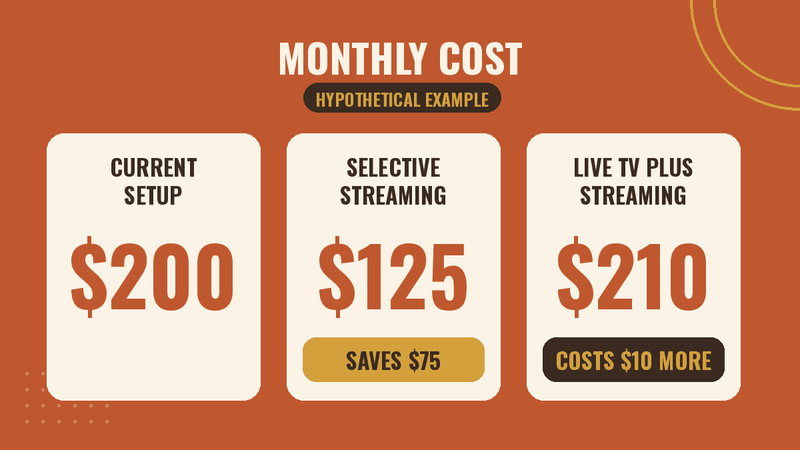
The following example uses hypothetical U.S. dollar amounts, not current provider quotes or national averages. Each monthly figure includes its applicable taxes and recurring charges. The comparison assumes prices remain unchanged for 12 months.
| Monthly expense | Current setup | Selective streaming | Live TV plus streaming |
| Internet and TV bundle | $160 | $0 | $0 |
| Additional TV equipment and fees | $20 | $0 | $0 |
| Internet-only service | $0 | $80 | $80 |
| Existing streaming subscriptions retained | $20 | $20 | $20 |
| Newly added on-demand subscriptions | $0 | $25 | $25 |
| Live TV streaming package | $0 | $0 | $85 |
| Total monthly cost | $200 | $125 | $210 |
| Monthly savings compared with current setup | — | $75 | −$10 |
The selective setup saves $75 per month, or $900 annually before switching costs. The larger setup costs $10 more per month, or $120 more annually before switching costs.
These options also provide different viewing experiences. The selective setup assumes the household can live without a paid live TV package. A household that needs those channels should evaluate the larger package against its actual viewing requirements.
How do setup costs change first-year savings?
Suppose either streaming option requires $120 in new equipment, with no cancellation charges or overlapping service costs.
| First-year expense | Current setup | Selective streaming | Live TV plus streaming |
| Twelve months of recurring costs | $2,400 | $1,500 | $2,520 |
| Switching equipment | $0 | $120 | $120 |
| First-year total | $2,400 | $1,620 | $2,640 |
| First-year savings | — | $780 | −$240 |
The selective setup saves $780 in the first year. The larger setup costs $240 more.
For the selective option, dividing $120 in setup costs by $75 in monthly savings gives a break-even point of 1.6 months. It recovers the setup cost during the second full month, assuming the projected savings hold.
An option with higher recurring costs has no savings-based break-even point unless those costs later fall.
Which costs can erase your expected savings?
The most consequential costs are those you overlook or underestimate: changed bundle pricing, additional subscriptions, sports access, and equipment purchased before you know what you need.
Could canceling TV change your internet bill?
Get a confirmed internet-only quote before subtracting the TV portion of your bill. Your current bundle allocation may differ from the amount you will pay after removing TV. Reviewing the remaining plan and price is part of the provider’s service-change process.
Ask for the recurring total, the offer’s expiration date, equipment charges, and any effect on linked discounts. Compare both options over the same period, including scheduled price changes.
Will your household need a more expensive streaming tier?
Count how many people watch simultaneously. Profiles, registered devices, and simultaneous streams are different allowances.
For example, YouTube TV offers up to six accounts, while its standard simultaneous viewing allowance is three devices. A household with more concurrent viewers needs to check the applicable plan and upgrade options.
Price the tier your household needs, including any required recording features, picture-quality upgrades, or viewing allowances.
Will sports require additional subscriptions?
Build your sports budget around specific teams and competitions. Check the channels and services carrying the games you want, including postseason events and exclusive broadcasts.
A package’s sports branding does not establish that every game is available. Viewing restrictions can depend on location, the event, and the device or platform.
For a seasonal subscription, count the months you will actually pay. A hypothetical $30 service used for four months costs $120 annually. Keeping it for the full year costs $360.
Do you need new internet service or equipment?
Test your existing connection and compatible devices before buying upgrades.
Netflix recommends a stable connection of at least 15 Mbps for a 4K stream. That is a recommendation for Netflix viewing, not a complete bandwidth requirement for a household running several streams and other internet activities.
Check performance where you watch, especially during busy evening hours. Also check your plan’s data allowance and any overage charges. Connection speed and monthly data usage are separate considerations.
Include streaming players, an antenna, installation, or Wi-Fi equipment only when you actually need them. Equipment you already own does not create a new switching expense.
Can free television reduce the replacement cost?
Free television can reduce the number of paid services you need when it covers content your household values. Consider free ad-supported streaming and over-the-air broadcasts alongside paid subscriptions.
An antenna may provide local broadcast channels without a monthly TV subscription, but reception depends on your location, surroundings, and equipment. Indoor reception can differ substantially from coverage predictions.
Test reception before relying on an antenna to replace local channels. Include antenna and installation costs in the first-year budget.
Free services are useful when their programmes match your viewing habits. They do not automatically replace specific premium shows, cable channels, or sports coverage.
What is the maximum you can spend and still save?
Your replacement budget is the amount left after paying for internet, retained subscriptions, and other continuing expenses.
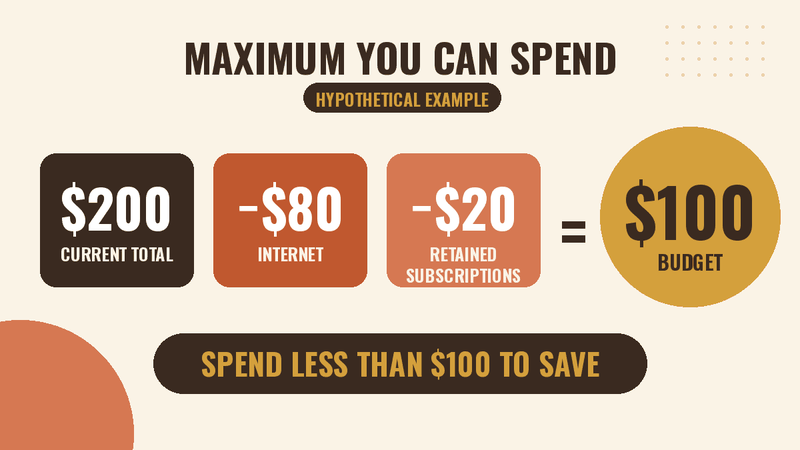
Using the hypothetical example:
$200 current total − $80 internet − $20 retained subscriptions = $100
The household can spend less than $100 per month on new TV services and add-ons to achieve ongoing monthly savings. Spending exactly $100 produces no recurring savings.
The $120 setup expense lowers the first-year break-even budget to an average of $90 monthly for new services:
100 − (120 ÷ 12) = $90
To save $50 per month on an ongoing basis, the household would cap new services at $50 monthly. Setting that ceiling before choosing subscriptions makes the trade-offs clearer.
What should you verify before canceling cable?
Verify that the replacement works for your household and that the quoted savings survive the switch.
- Confirm must-have viewing. Check specific channels, shows, local broadcasts, and sports events.
- Test household use. Try simultaneous viewing, recordings, captions, and navigation on the devices you use.
- Confirm cancellation costs. Check notice requirements, final billing, equipment returns, and any early termination charges.
- Budget for overlap. Include any period when you pay for both the old and new services.
- Set renewal reminders. Track trial endings, promotional expirations, and seasonal subscriptions.
Use a trial when available, and review its billing terms before starting. After switching, compare the first complete set of bills with your estimate.
Will cutting the cord save your household money?
Cutting the cord saves money when the services your household needs fit below the spending you eliminate, after accounting for changed internet pricing and switching costs.
Start with your actual bills, obtain the internet-only quote, and set a replacement budget. Choose the smallest combination that meets your household’s viewing needs, then compare its full first-year cost with staying.